Losing a tooth is more than a cosmetic concern; it is a deeply personal one. Complicated treatment procedures can make you anxious and confused. Endosteal implants are today’s gold standard solution, and for good reason.
In this guide, we’ll break down why it’s one of the most commonly used implants today. This guide contains all the information you need if you’re thinking about dental implants or just want to learn more about your options.
What Is an Endosteal Implant?
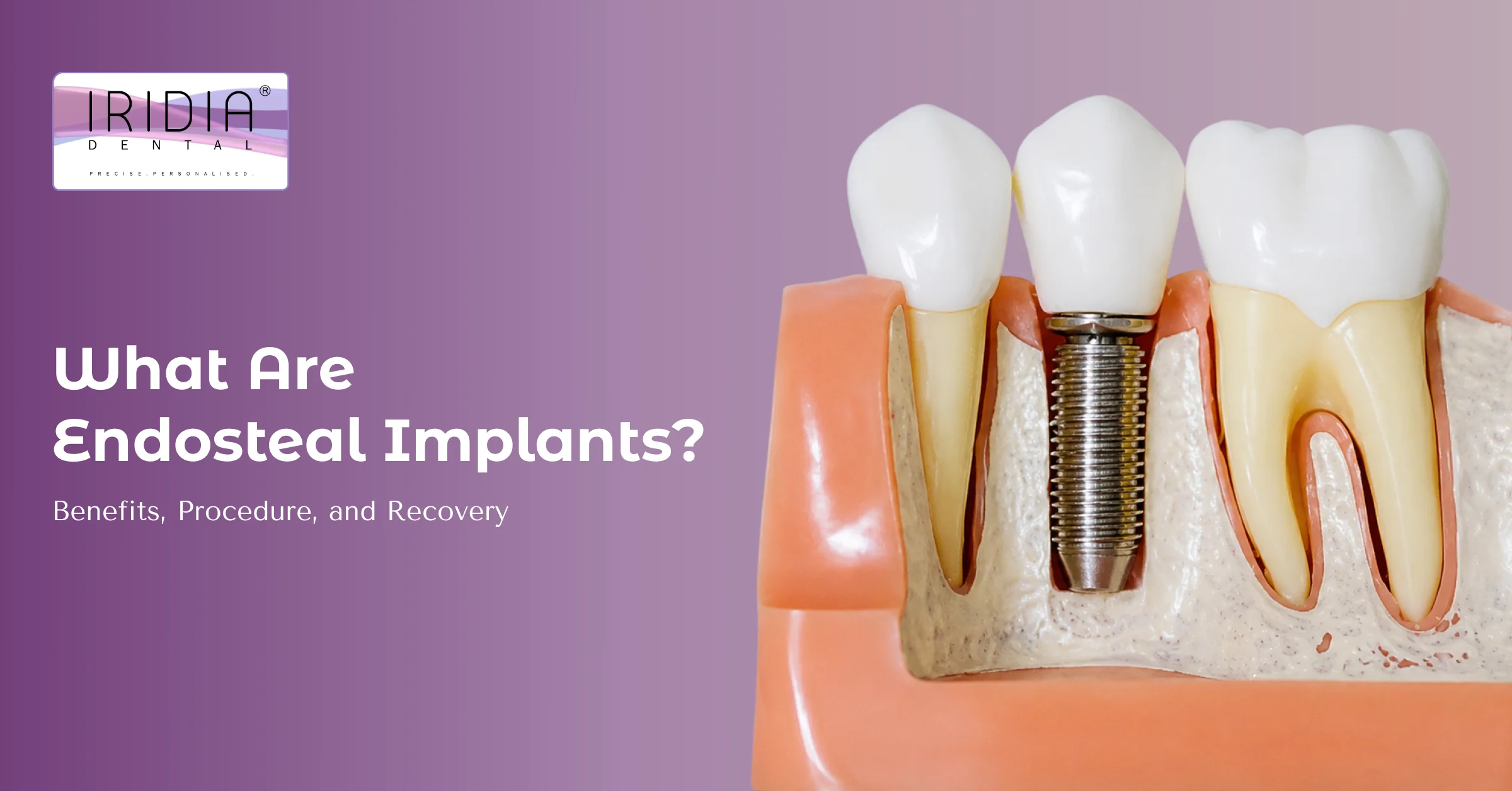
An endosteal implant is directly inserted into the jawbone to act as an artificial tooth root and represents the dominant standard in modern implantology. Their design most closely mimics the natural root structure of a tooth. Once the implant fuses with the bone, a crown is attached on top, giving you a replacement tooth that looks, feels, and functions like a natural one.
The word “endosteal” comes from “endo”, meaning within, and “osteal”, meaning bone. Simply put, it lives inside your bone.
What are the Types of Endosteal Implants?
Not all endosteal implants are the same. Here are the main types:
1. Root Form Implants (Screw Type):
The post that sits within the bone closely resembles the shape of a natural tooth root. They are used in most standard implant cases.
2. Blade Implants:
These have a flat, blade-shaped post that fits easily in cases where the jaw sections are narrow and where screw-type implants may not fit. They are less commonly used today.
3. Ramus Frame Implants:
The ramus is a part of the lower jaw. These implants are placed in the back section of the lower jaw. They are used in cases of severe bone loss in the front of the jaw.
What are the Benefits of Endosteal Implants?
Endosteal implants are not a new concept. They have decades of clinical research and patient results backing them. The presence of this clinical evidence is why dentists call them the gold standard in tooth replacement.
They work like your natural tooth.
Endosteal implants provide a bite force range between 200 and 400 newtons, which is beneficial for normal dietary function. Along with that, the crown sits above the gumline just like a real tooth. The bite force also increases as the implant continues to fuse more effectively with the jawbone.
They protect your jawbone.
Most people do not realise that the moment a tooth is lost, the jawbone beneath it begins to shrink. Without the stimulation of a tooth root, the bone has no reason to maintain its density and volume. This is called bone resorption, and it is irreversible without intervention.
Endosteal implants are the only tooth replacement option that actively prevents the jawbone from receding, a common side effect of tooth loss. By replacing the function of a natural root to an extent, they keep the jawbone stimulated and intact, protecting your jaw structure, bite, and long-term oral health.
They do not compromise your adjacent teeth.
Endosteal implants are completely independent. They are anchored in bone, which means your surrounding teeth remain preserved. In contrast, a traditional bridge requires some form of reduction on the adjacent teeth.
Implants also reduce the risk of decay and endodontic complications in adjacent teeth, a meaningful long-term advantage over bridge-based restorations.
Backed by decades of clinical evidence
Endosteal titanium implants are now the most widely used option for replacing single teeth as well as partial and full mouth cases, with successful outcomes consistently validated across decades of clinical use.
According to Dr. Randolph R. Resnik in Misch’s Contemporary Implant Dentistry, when patient selection and surgical planning are thorough, endosteal implants deliver the most predictable and durable long-term outcomes of any tooth replacement treatment available today.
They are built to last
Endosteal implants are one of the few treatments designed with permanence in mind. Once the implant fuses with the jawbone, it becomes a part of your skeletal anatomy, not just something resting against it.
Titanium itself contributes significantly to this durability. It is corrosion-resistant and one of the few materials the human body accepts without attempting to reject or encapsulate. It does not wear down under the mechanical forces of daily chewing, the way softer materials might over years of use.
They restore your confidence and daily function
Endosteal implants restore something that other solutions cannot fully offer: confidence. No food restrictions. No slipping or shifting. No adhesives. No removing anything at night. You eat, speak, laugh, and smile the same way you would with natural teeth.
For younger patients, especially, this is significant. An endosteal implant placed in your 30s or 40s can serve you for the rest of your life, making it not just the most effective solution but often the most cost-efficient one when viewed over time.
Who Is a Suitable Candidate for Endosteal Implants?
Endosteal implants work well for most healthy adults.
The key requirements are:
- Adequate jawbone volume and density to support the implant
- Healthy gums with no active periodontal disease
- No uncontrolled systemic conditions, such as unmanaged diabetes
If bone volume is insufficient, a bone graft may be performed before implant placement to build up the site.
What Happens During the Endosteal Implant Procedure?
Let’s review the process of placing an endosteal implant:
Step 1: Consultation and Imaging
Your dentist takes X-rays and 3D scans to assess bone volume, density, and the position of nerves and sinuses. A full treatment plan is created before any procedure begins.
Step 2: Bone Grafting (if required)
If your jawbone lacks sufficient volume, a graft is placed and given time to heal, typically 3 to 6 months before implant placement.
Step 3: Implant Placement
Under local anaesthesia, a small incision is made in the gum. The jawbone is prepared, and the titanium post is inserted. The gum is then sutured closed.
Step 4: Osseointegration
This is the healing phase where the implant fuses with the surrounding bone, a process called osseointegration. This typically takes 3 to 6 months and is what gives the implant its exceptional stability.
Step 5: Abutment Placement
Once osseointegration is confirmed, a small connector piece called an abutment is attached to the implant post. This is what holds the final crown.
Step 6: Crown Placement
A custom-made crown matched to the colour and shape of your natural teeth is fixed onto the abutment. At this point, the process is complete.
What Is the Recovery Process for Endosteal Implants?
- Days 1 to 3:
Mild swelling, bruising, and discomfort are normal. Pain is managed with over-the-counter medication. A diet of soft food must be followed. - Days 4 to 7:
The swelling starts to go down. Most patients return to normal activities within a few days. - Weeks 2 to 4:
By this time, the gums heal fully around the implant site, but a diet of soft food has to be maintained so that the healing process is not disturbed. - Months 1 to 6:
Osseointegration takes place beneath the surface. No discomfort during this phase for most patients.
Post-procedure care tips:
- Rinse gently with warm salt water
- Avoid smoking throughout the healing period.
- Brush carefully around the implant site
- Attend all follow-up appointments
- Avoid hard foods until your dentist clears you.
Final Thoughts
Endosteal implants are one of the best treatment options for tooth loss. They are trustworthy for long-lasting, efficient results that will not only replace the natural tooth’s function but also preserve the jaw bone, remaining natural teeth and surrounding tissues. Years of research and patient outcome data have proven their effectiveness, making these implants a standard treatment option and not just a choice.
Endosteal implants have given thousands of patients back their confidence, their comfort, and their quality of life. At IRIDIA Dental, we combine in-house CBCT imaging with years of specialised experience to deliver implant outcomes that are built to last. Your scan is taken, reviewed, and planned entirely within our clinic, with the placement guide 3D printed from your imaging data to ensure precise, patient-specific positioning on the day of surgery.
Book your consultation and take the first step toward lasting oral health today.
Frequently Asked Questions
Recovery is gradual and manageable. Most patients resume normal activities within a few days, with mild swelling and discomfort in the first 72 hours. Full osseointegration, where the implant bonds with the bone, takes 3 to 6 months, though most people feel completely normal well before that.
In most cases, very little. The titanium post remains stable and integrated with the bone. The crown on top may show wear and need replacing, but the implant foundation itself is designed to last a lifetime with good oral hygiene and regular dental visits.
The procedure itself is performed under local anaesthesia, so there is no pain during placement. Most patients describe the post-procedure discomfort as milder than they expected, manageable with standard over-the-counter pain relief for a day or two.
The complete process typically takes 6 to 12 months, depending on whether a bone graft is needed before implant placement.
References:
- Misch, C.E. (2021). Contemporary Implant Dentistry (4th ed.), available at https://studylib.net/doc/27296913/mischx27s-contemporary-implant-dentistry-4th-editionpdf-c…
- Ranjan Gupta, Neha Gupta, Kurt K. Weber, DDS, 2023, Dental Implants, available at https://www.ncbi.nlm.nih.gov/sites/books/NBK470448/