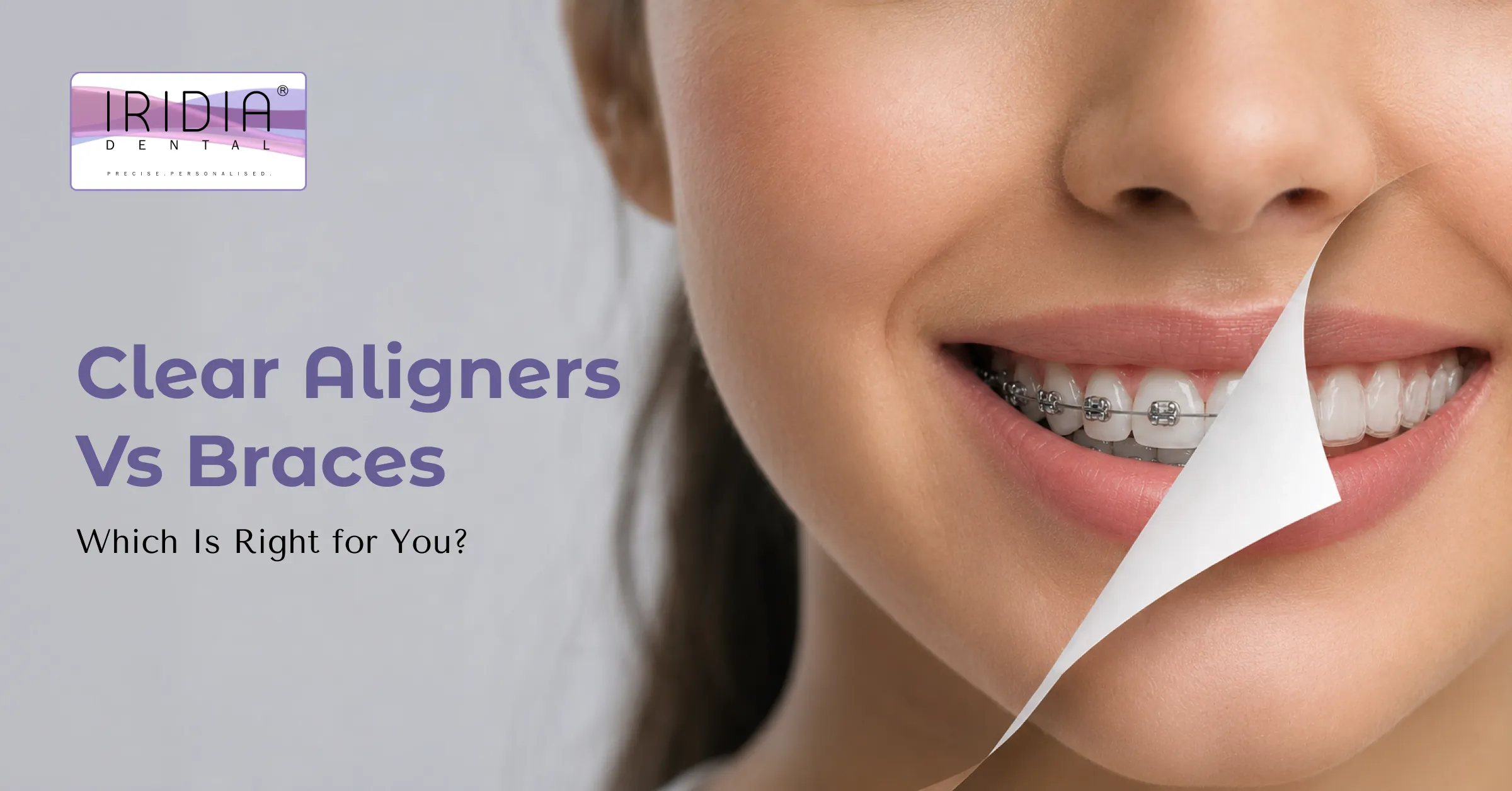
Wondering why there are two treatments for the same issue? You’ve decided to straighten your teeth but don’t understand the difference between clear aligners and braces. Don’t worry, this guide will walk you through the pros and cons of both treatments to help you decide which is best for you.
Both are trusted. Both work. But they are not the same treatment, and the right choice depends on your teeth, lifestyle, and your orthodontist’s evaluation.
First, let’s understand what traditional braces and clear aligners exactly are.
What are Braces?
- Metal or ceramic brackets are attached directly to each tooth’s surface.
- The brackets are then connected by wires that your orthodontist tightens at regular intervals.
- These brackets stay fixed in place for the full duration of treatment.
- They are available in metal (standard) or ceramic (tooth-coloured) options.
What are Clear Aligners?
- Aligners consist of a series of custom-made, removable clear plastic trays
- Each tray moves your teeth gradually into the desired position
- These trays are changed every 1 to 2 weeks throughout treatment
- They ust be worn 20 to 22 hours a day to be effective
Clear Aligners Vs Braces: A Side-by-Side Comparison.
Let’s understand the differences between the two in different aspects like aesthetics, duration, cost etc. The main difference between aligners and braces is that one stays on your teeth at all times and works constantly. The other works only when you wear it.
| Factor | Clear Aligners | Braces |
| Comfort | Smooth plastic trays with minimal irritation. No sharp edges or brackets | Metal brackets and wires can cause soreness, especially in the first few weeks. Most patients adjust over time |
| Aesthetics | Nearly invisible. Most people will not notice you are in treatment | Clearly visible metal or ceramic brackets on the teeth |
| Treatment Procedure | Digital 3D scan at consultation. Custom trays delivered and changed every 1-2 weeks. Fewer clinic visits every 6-0 weeks | Brackets bonded at fitting appointment. Adjustments made by orthodontist every 4-8 weeks throughout treatment |
| Cost (India) | From ₹80,000 onwards | Metal: ₹40,000+Ceramic: ₹60,000+Lingual: ₹1,20,000+ |
| Duration | 12-18 months for mild to moderate cases. Longer if wear time is inconsistent | 18-24 months on average. Up to 3 years for complex cases. Works continuously since it cannot be removed |
| Oral Hygiene | Remove trays to brush and floss normally. Standard oral care routine applies | Requires extra effort. Interdental brushes and floss threaders needed to clean around brackets and wires |
| Effectiveness | Best for mild crowding, small gaps, and simple bite corrections in disciplined wearers | Better suited for complex cases including major bite issues, significant crowding, rotations, and younger patients |
Do You Always Have a Choice Between Aligners and Braces?
This topic is an important part of the conversation, but it does not always come up. In certain clinical situations, your orthodontist will recommend braces regardless of your preference because they are simply the more appropriate treatment.
Braces May Be Required When:
- Your jawbone requires some form of change
- Your case involves complex bite-related corrections that aligners cannot reliably achieve.
- You need surgical intervention before the treatment begins.
- Your teeth require movement in multiple directions at the same time.
Clear aligners are excellent, but they are not designed for every case. A treatment plan that suits your smile takes priority over personal preference, and a good orthodontist will always be direct about the issue.
Need Help Deciding Which Treatment Your Smile Actually Needs?
Book a consultation at Iridia Dental for a personalised orthodontic assessment from specialists who will tell you exactly what your teeth need, not just what is most popular.
Clear Aligners Vs Braces: Pros and Cons
Clear Aligners
| Pros | Cons |
| Hidden and nearly invisible | Highly dependent on how well the patient follows the aligner routine |
| Can be removed while eating, brushing, and flossing | Cannot be used for complex or severe cases |
| Comfortable to wear | Can easily be lost |
| Fewer clinic visits needed | Can be more expensive than braces |
| Digital treatment planning that lets you preview your result beforehand |
Traditional Braces
| Pros | Cons |
| Effective in all cases whether severe or simple | Visible on the teeth |
| Less dependant on patient compliance | Dietary restrictions during treatment |
| More affordable comparatively | Requires focused oral care and effort in maintaining the brackets |
| Reliable results for complex cases | Adjustment appointments can cause some soreness right after |
Final Thoughts
The best treatment is the one that matches your clinical needs, your lifestyle, and your level of commitment.
If you want something discreet and can commit to wearing your trays consistently, clear aligners are worth exploring. If you have a more complex case, or simply prefer a treatment that does not require daily discipline, braces are a time-tested and reliable option.
In any case, a consultation with your dentist is the first and most important step to make the right decision.
Take the First Step Towards Your Desired Smile
At Iridia Dental, our orthodontic specialists assess your case thoroughly and recommend what is right for you, not what is trending. Whether that is clear aligners, braces, or a combination approach, you will leave with a clear plan tailored to your teeth.
Book Your Consultation at IRIDIA Dental Today
This blog is intended for informational purposes only and does not substitute professional dental or orthodontic advice. Always consult a licensed orthodontist for a clinical assessment.
Frequently Asked Questions:
Clear aligners are generally faster for simple cases, averaging 12 to 18 months compared to 18 to 24 months for braces.
Neither is universally better. Aligners work well for simple cases. Braces are more effective for complex corrections.
Yes, for simple cases. For severe or complex cases, braces typically deliver more controlled results.
In some cases, yes. It depends on your stage of treatment and what movements still need to happen. Your orthodontist will check whether a switch can be made or not.
Most orthodontists recommend a first evaluation around age 7. Treatment usually begins between ages 11 and 14, but adults can start treatment at any age.
References:
- Abdul Majeed Al Mogbal, 2025, Patient Satisfaction with Clear Aligners vs. Traditional Braces: A Comparative Study, available at, https://pmc.ncbi.nlm.nih.gov/articles/PMC12244812/
- Yunyan Ke, Yanfei Zhu, Min Zhu, 2019, A comparison of treatment effectiveness between clear aligner and fixed appliance therapies, available at, https://link.springer.com/article/10.1186/s12903-018-0695-z
- Fan Liu, Yanhong Wang, Danzeng Luopei, Xiaofu Qu, Lin Liu, 2024, Comparison of fixed braces and clear braces for malocclusion treatment, available at, https://link.springer.com/article/10.1186/s12903-024-04469-2